
Finding a Life's Purpose Behind Bars

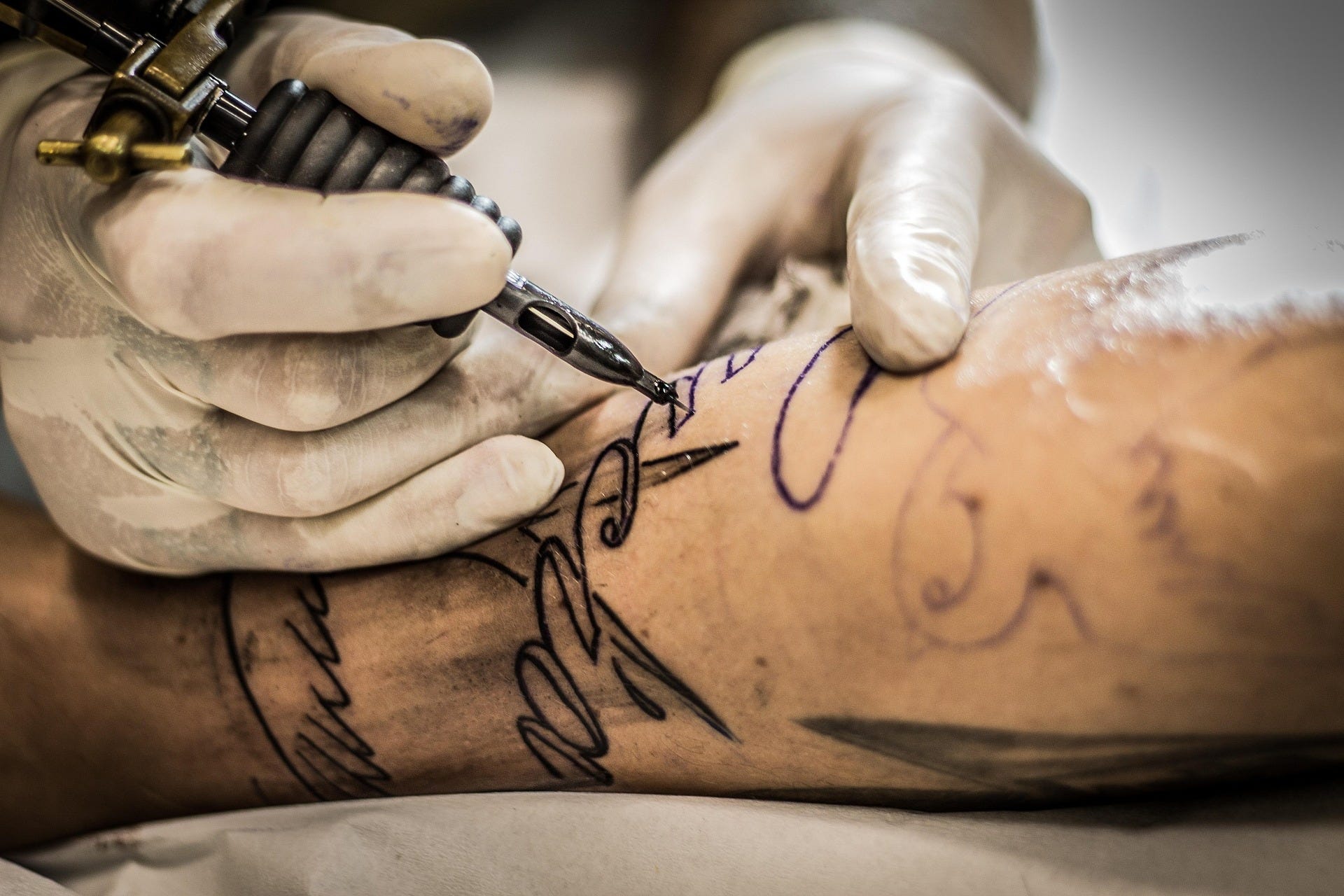
Prison tattoos aren’t usually elaborate works of art. In fact, most are blurred monstrosities about as detailed as a five-year-old child’s drawing. I have enough messed-up tattoos to know. I regret each one, but not as much as my friend Tommy regrets the Yosemite Sam on his forearm with the crooked mustache, or those who got the standard “13 1⁄2” tattoo on the web of skin between their thumb and forefinger, meaning 12 jurors, one judge, and a half-ass chance.
Every once in awhile I encounter a decent prison tat, but I never saw professional work produced in prison until I met a heavily-tattooed artist named Sketch (an alias I created for his protection).
Sketch tatted a sleeve on my old bunkmate Terrell. The tattoo used heavenly artwork, like crowns and angels’ wings, as fillers to link detailed portraits of Terrell’s three kids and his mom and dad. The faces of Terrell’s family looked so real that they could speak to me.
The average prison tattoo artist, who works to get high or to buy honey buns, can’t produce Sketch’s level of work because they’re focused on the reward, not the art. Sketch tattoos so well because he’s an artist with purpose, and purpose makes all the difference.
Over the years, I’ve met several cons who mastered skills: arts and crafts, fixing radios and cellphones, even learning languages. The skills they learned never impressed me as much as the dedication it took to master them. Accomplishing anything in life requires a sense of purpose. Without it, effort lacks the drive to follow through when learning becomes a challenge.
For those who have never been incarcerated, one’s purpose seems synonymous with rehabilitation. So society expects prisoners to strive for change simply because we are in prison. It doesn’t work that way. Such a narrow view fails to consider how the carceral environment stymies rehabilitation instead of promoting it.
Poverty in prison is the most efficient destroyer of purpose. Focus drives a person to either redemption or ruin, and poverty in prison causes us to focus on the wrong things. When the price of a microwavable cheeseburger costs double what you earn in a week of working a prison job, you prioritize making the ends meet, not redefining yourself. Because most prisoners enter prison poor, the culture is made up of survivalists who do whatever it takes to make money, so the environment remains largely negative.
Lucky for Sketch, tattooing is one of the most lucrative hustles in prison. He charges $75 to tattoo a portrait of one person. He does sleeves that cover the arms, whole back pieces, and anything else one can think of, unless it’s disrespectful to a gang or religion. The pay is great, but Sketch isn’t in it just for the money. Creating art drives him.
Raised on the north side of Chicago, the Puerto Rican and Italian artist has never taken a formal art class. He liked to draw as a boy. When he got a little older, he used to ask his mom to drop him off at the L-train yards to tag the cars so his name could be seen throughout the city. Eventually, his mom figured out what he was doing, but she didn’t make him stop.
“She used to buy me spray paint,” Sketch told me as we sat in a day room at Neuse Correctional in Goldsboro, North Carolina. “One time I got her to spray paint her name on a bridge,” he mused with a smile while staring off into space. “I love my mom.”
Chicago cops arrested Sketch at about 10 years old for tagging trains.
Sketch tattooed for the first time in the Kane County Youth Home in St. Charles, IL, now called the Juvenile Justice Center. His friends took a motor from a cassette player and made ink from melted chess pieces. They asked him to tattoo them because he could draw so well. He was just 13.
Sketch liked tattooing so much that he became an apprentice at 20. He left the tattoo shop shortly after, when he realized he could make more money tattooing for half price from home. Incarceration thwarted his plans.
For 17 years of incarceration, Sketch has been honing his craft with a single-needle tattoo machine he built using miscellaneous parts, like an ink pen, rubber bands, and the tube from a spray bottle. The ink is made from burnt hair grease. Sketch can’t work in the open. He must tattoo in secret. Getting caught will net him weeks in the hole. He has to stop and hide his equipment each time a C/O makes a round in the cellblock. Tattooing is risky and stressful, but worth it, he said.
“It’s like barbering,” Sketch told me. “A barber cleans people up — makes ‘em feel like a new man. With tattooing, you give them something they’ll carry for the rest of their life. If it’s a portrait of a loved one who passed away, I get to memorialize someone they loved. It makes me feel good to see how happy they are with my work. And when my people used to post pictures of my stuff online, other tattoo artists didn’t believe I’d created my art with a single needle.”
Even though Sketch is getting by, he isn’t happy working illegally.
“The North Carolina prison system should offer an apprenticeship in tattooing,” he said. “It’s a marketable trade to learn before release. It makes sense, because we’re going to do it anyway. Why not open a school?”
Such a program already exists in Minnesota prisons. For a few years, MCF-Stillwater has operated a tattoo apprenticeship program, as reported by Patrick Bonga for the Prison Mirror, a prison newspaper1. The program gives incarcerated artists an opportunity to work in a safe, sterile environment under the tutelage of an experienced instructor. The school charges prisoners $25 a session for tattoos. So many want to get inked that they have a waiting list nearly 200 names long.
Maybe North Carolina could use the Stillwater program as a model.
Finding a purpose in prison doesn’t always mean engaging in illegal activity. Those who buck the norm of focusing on survival stand out. It’s easier if they have financial support from home. That way they don’t need to hustle or work. They can pursue education, because they’re not worried about scrounging up money to buy a $9 stick of deodorant or to buy tablet time to text their kids. But then some people grow into a purpose after being rooted in hardship.
Trevor Muhammed has served 31 years in North Carolina’s prisons. As a wheelchair-bound disabled man, he has faced innumerable injustices while behind bars. To address them, he writes grievances that sometimes lead to civil action.
Writing a grievance is a prisoner’s only formal method of complaint against a prison policy or injustice. These complaints are first answered by the prison, then the Inmate Grievance Review Board (IRGB), a panel of attorneys appointed by the Secretary of the North Carolina Department of Adult Correction (DAC).
North Carolina implemented the grievance procedure, or the Administrative Remedy Process, in the 1970s at the direction of the Supreme Court of the United States. At the time, a group called the North Carolina Prisoners’ Labor Union (NCPLU) was pressuring the prison system to make changes, as explained by Amanda Bell Hughett, a University of Illinois Springfield associate professor who has published several articles on prison labor and policy in North Carolina prisons2.
With 2,000 incarcerated members, the NCPLU instituted work stoppages across the state to protest work with no pay, and they filed a slew of lawsuits to improve prison conditions. When the state fought back, with aid from the federal government, the Supreme Court shut down the NCPLU by forcing North Carolina to use the grievance procedure3. The court hoped prisons would address problems before they became civil actions. Later, the Antiterrorism and Effective Death Penalty Act became law, requiring prisoners to file a grievance before filing a lawsuit, while also adding a $400 filing fee for filing a lawsuit from prison.
Personally, I’ve always viewed the IGRB as a rubber stamp against prisoner complaints, not an impartial adjudicator4. It serves more as an impediment to remedies than a conduit. So I rarely write grievances. They’ve done me no good.
The ineffective remedy procedure hasn’t stopped Muhammed. His physical stature may not be imposing from a wheelchair, but his intellect is.
Muhammed recently filed a grievance because the chow hall regularly serves undercooked and inedible green peas. What may seem like a minor complaint to some is a major problem to those who only receive one vegetable per meal.
His complaint is one I share. Peas are my favorite vegetable. I love the mushy, buttery warmth that explodes in my mouth when chomping on a spoonful. But the peas at Neuse are always hard and waxy. Disgusting. I end up throwing them away because I can’t stand to eat them.
In response to Muhammed’s grievance, a prison administrator wrote on March 4, 2026, “...foods are cooked to standard temps (sic) by policy and no deviations are made unless authorized standards. Staff deny (sic) the allegations and have explained that during time (sic) of inclement weather or hazards were put on Emergency Feeding Schedules per policy.”
In plain English translation, they were trying to blame the raw peas on a snow day, but one occurrence doesn’t account for the Nth other times peas shattered bicuspids when chewed.
Regardless, prison officials always deflect when answering grievances. They never address the actual complaint or take accountability. They concoct some cockamamie excuse to appear blameless instead of simply fixing the problem. That’s why Muhammed files lawsuits.
Muhammed recently went to court in Wayne County for a lawsuit he filed, alleging Neuse retaliated against him for filing grievances. It all stemmed from a shakedown.
On October 16, 2025, the Prison Emergency Response Team (PERT) performed an institutional search at Neuse. I’ve been through many at several prisons. They’re always demoralizing, yet this last one proved to be the worst.
After laying on our bunks for four hours, we were strip-searched in the bathroom and forced to sit in the day room with our backs to the bed area so we couldn’t see the camouflage-clad C/Os ransacking our dorm. I heard lockers slamming, mattresses ripping, and plastic crunching beneath the weight of thick-soled boots. When we were allowed to clean up, I found all my property heaped into a pile like garbage in front of my locker. Some guys found their family’s photos mixed in with someone else’s property 20 feet away.
A few guys yelled and cursed at C/Os, “Man, why y’all do us like this?!” While others just stared at the destruction with clenched fists.
They didn’t have to disrespect us. They chose to, which seemed worse.
I felt my heart racing, my breathing quick and shallow, and knots in my belly, but I wasn’t enraged like everyone else. If I felt hate, I hated that people had unchecked power over me, and I could do nothing about it.
It took two hours to put my locker back together.
Muhammed got it the worst. PERT confiscated most of his property without him knowing. He discovered that items were missing while cleaning up the mess. Later that day, a C/O called him to an office and pointed at a few garbage bags in the corner on the floor. “Is that your property?” The C/O asked. “I found it in the trash.”
“They didn’t find it in the trash,” Muhammed told me. “They took shower shoes, my inhaler, bottles of lotion — none of that had my name on it. They knew it was mine because they deliberately took it to find out what I was writing against them.”
During the court hearing, Muhammed argued his case against an educated deputy attorney general who filed a motion to dismiss his lawsuit. After weighing the evidence, the judge found merit in Muhammed’s argument and allowed the case to proceed.
“My purpose isn’t to take down the system,” Muhammed said with a chuckle. “They might think that, but it’s not. I’m not seeking money. I do what I do for the betterment of everybody. If they’ll do it to me, they’ll do it to you. So we have to stop them.”
Years ago, Muhammed filed a grievance while serving time at Pender Correctional, alleging that the prison didn’t adhere to his rights under the Americans with Disabilities Act, a federal law mandating equal treatment for handicapped people. In retaliation, Pender, a medium-custody prison, transferred Muhammed to Maury, a close-custody prison, where he spent seven months in a cell on 23-hour lockdown without just cause. Demotion to close custody from medium custody is usually reserved for incorrigible prisoners, not those filing complaints.
“People are afraid to address problems in here because of retaliation,” Muhammed said. “I don’t care. I’m used to it. We have a First Amendment right to a redress of grievances. Why shouldn’t we use it?”
Finding a purpose in prison isn’t always about employing artistic talent, like Sketch, or righting systemic wrongs, like Trevor Muhammed. Sometimes finding a purpose in prison is unintentional.
Jovan Wash has been incarcerated for 19 years. In that time he has become a fitness guru that many seek to train them, whether he wants to or not.
For decades, men like Wash had it easy because every prison offered free weights on the rec yards. Pumping iron had always been the prisoner’s preferred choice of exercise. But at the turn of the century, the demographics of newly hired C/Os changed. Until then, male prisons employed a majority of men — ex-military grunts who craved imposing structure on the unruly prison population. However, low wages and diminishing health benefits forced those macho men into other jobs. The state hired whoever they could, which meant a lot of young women who couldn’t physically overpower a brute who bench pressed 415 pounds ten times.
In the early 2000s, a C/O once told me that North Carolina prisons were removing free weights because “Y’all inmates are whuppin’ C/Os across the state.” Prisons replaced the weights with pull-up and dip bars, forcing fitness aficionados, like Wash, to rely on calisthenics to stay fit. Lots of pushups and cross-fit workouts.
Wash didn’t build his physique in prison. He played sports growing up. Working out always seemed like a necessity rather than a hobby.
“About 13 years ago,” Wash told me, “guys on the yard started asking to work out with me. When I transferred to other prisons, the same thing happened. It’s odd, because I’m an introvert. I like being alone, but I always had five to eight guys following my lead.”
Wash’s workout partners asked him how they could build a physique like his. He’d been studying the body for years, so he gave them his recipe for success: no bread, as little sugar as possible, and lots of protein. Eating healthy proved nearly impossible in prison, but when one or two guys adopted his disciplined diet, he noticed as their bodies transformed. He realized how he inspired others to be better.
“Six years ago I decided to become a personal trainer when I get out,” he said. “I know it sounds cliché, but I didn’t choose a purpose. My purpose kinda chose me.”
At the time, a prisoner couldn’t become a certified personal trainer in North Carolina prisons. If his family paid for correspondence courses out of pocket, he would still lack the required in-person training he needed. Facing such limitations didn’t stop him. It made him work harder to learn as much as he could before his release in 2035.
I usually see him on the yard working out two to three times a day, at least five days a week. I’ve never seen someone so dedicated. His first workout is during the morning yard call with six or seven guys. He leads them through a grueling cross-fit routine of his design that centers on strength training mixed with heart-pounding cardio. After lunch he trains a wheelchair-bound man who suffers from multiple sclerosis. Most evenings, he works out alone, jogging or doing burpees and ab work.
“I train for endurance, because when I get out, I might have to train 10, 20, or 30 people a day,” he said. “That’s a lot of work, and I need to be ready.”
Prison officials took notice of Wash’s work ethic and asked him to create a fitness program for the entire population. He called it “Fitness Bootcamp.” One workout session involves 10-30 people who separate into three groups: beginners, intermediate, and advanced. Wash designs the workouts for the groups that work out at the same time.
In early 2026, the DAC began offering personal training certifications through correspondence for select prisoners across the state. Wash became one of the first participants. He had to study a book and take a comprehensive exam on nutrition and fitness. On February 2, 2026, Wash became a certified trainer with the Master Personal Training Program from Stronger Sport Science.
Completing the course brought him one step closer to his goal and to realizing his life’s purpose.
Examining how others discovered their purpose in prison made me think of my own. How did I arrive at this point in my life? I didn’t always want to write. I always had stories in my head, but seeking success from prison seemed impossible. In the beginning, I used writing to escape from prison, not as a purpose.
Even as I write these words, the cellblock I am housed in is flipping upside down. Two men are in the bed area shouting at each other, making the walls tremble. Men from all over the block converge on the fray, craning their necks to see what will happen next. But not me.
When the argument began, I hurried to the day room and sat at a table where Draft Two of this essay lay waiting. I wedged noise-cancelling Skullcandy headphones into my ears and blasted 92.7 FM to drown out the craziness around me. While Nas rapped “If I Ruled the World,” tears wet my eyes as I thought about how I longed to be somewhere else.
I didn’t know if those men fought. I didn’t care. I was tired of men fighting. So I picked up my clear Pentel mechanical pencil, and I wrote. Blasting my radio and scribbling meaningless words has always taken me away. Without writing, I wouldn’t have survived 25 years in prison.
I began seeing writing as my purpose when I turned to journalism. Crafting news stories gave me a chance to address injustices, like overcrowded prisons, the high cost of communication, and the toll incarceration takes on human beings. Pursuing wealth and awards didn’t seem realistic. I strived to make my circumstances better by reporting on the hardships I experienced. I reasoned that if our lives were better in prison, we would be better people when released.
Like Sketch I worried about potential punishments for my art. In 2007 I attempted to mail the draft of a novel to a publisher in New York. Central Prison’s mailroom stopped the package and administrators sent me to the hole. The charges? Continuing a business venture, for one. They even wrote me up for misuse of state property because I wrote the book on state-supplied paper.
Luckily, another prisoner named Victor L. Martin had already filed a lawsuit challenging Central Prison’s policy on prisoners corresponding with book publishers, and he was winning5. The prison dropped the charges five days later. I still remained wary of the repercussions my writing could bring years afterward.
Like Trevor Muhammed, I too experienced retaliation when I transferred to another prison after publishing a few articles challenging our conditions of confinement. So I knew how it felt to be abruptly uprooted and shipped off to a worse prison for no reason.
And like Jovan Wash, I’m dedicated to my craft through the good days and the bad. Writing was my best friend when I had only one phone call a year at Central Prison for Christmas (they installed phones in about 2008). In those days, I rarely received mail. It was the loneliest time of my life, and I unloaded my troubles on a blank piece of paper in the confines of my single cell.
Thinking about how writing saved me reminds me of something Wash told me when spoke.
He said, “Some of the reason I work out is to maintain my mental health. I’m trying to stay sane in an insane environment. It’s the one thing that brings me peace — my therapy, I guess.”
I couldn’t agree more. Without the purpose I found in prison, I would be lost.
https://americanpenalpresscontest.org/wp-content/uploads/2025/09/3-Visual-Journalism.pdf
Amanda Bell Hughett, “From Extraction to Repression: Prison Labor, Prison Finance, and the Prisoner’s Rights Movement in North Carolina,” in Labor and Punishment: Work In and Out of Prison, ed. Erin Hatton (Oakland: University of California Press, 2021), 51-85.
Jones v. North Carolina Prisoners’ Labor Union, Inc., 433 U.S. 119, 97 S. Ct. 2532, 53 L.Ed.2d 629 (1977).
Phillip Smith, “Revisions and History of the Inmate Grievance Procedure,” North Carolina Prison News Today, Vol. 1, Iss. 1, 2024.